Showing posts with label Chenango County. Show all posts

Monday, June 21, 2010

Chenango Darkness: the Prequel


June 7th, 1879, in the New York Times:
In the previous entry in this blog, writer Frederick Busch drew a parallel between his almost-murder in Nigger Hollow, Chenango County, NY, to a completed one in the previous century in the same place. He wrote of the murderer, "He used his rifle, this man who is a small notation in history, and he shot through an open window, and he killed the man whose chickens scratched among the onions and the beans."

Busch got it backwards.

The killer in question killed because the damn' neighbor had killed two of his pet chickens, intentionally, and had lured them to their demise to boot. That's a shooting that I, a chicken-keeper, can understand.

And, besides, a thoroughly unpleasant person played a key role in the chicken-entrapment:


The whole story is recounted in this anonymous article from the New York Times of June 7th, 1879, and is at least as good reading as is Busch's tale from almost a century later. (Beware: the PDF file linked from that page is a little odd: you have to scroll halfway down the image to get to the start of the article in the left column.)


(So, I guess I have to thank my quarrelsome neighbors here in Creepy Hollow, California, for keeping the neighborhood from stagnating. Whoda thunk it.)

A plus in this well-written and engaging article from 131 years ago is that it doesn't take a gratuitous swipe at its then-current Presidential administration, something that caused consternation in comments about Busch's article linked in the previous blogpost. I'm happy to reassure the politically squeamish that the NYT did no such thing to the Hayes administration in this article (although there are some striking similarities between that administration and some controversies about the second Bush administration.) Dann, you can read the original article linked in this post without fear that your delicate sensitivities will be trod upon.

As a more serious side-note, the murderer -- who comes across very sympathetically in the article -- has a couple of interesting connections to "SherWords" and its readers: he was an immigrant from County Monaghan to County Chenango, and he was almost stony deaf. The latter makes some of the later parts of the article even more poignant, given the significant percentage of readers of this blog who are intimately familiar with that condition.

(One little correction: the reporter says that Chenango County is North of Utica; it is actually South of Utica, and by somewhat more than 11 miles.)

Sugar is a Ft. Harrington chicken. Mess with her at your own risk. Significant risk.

Once again, here's where to go for the original 1879 New York Times article about the hanging of Felix McCann. Happy reading!

============================================

Saturday, June 12, 2010

Chenango Darkness: Disturbing Tales from Close to Home

I take this brief break from my break to pass along a find from an old Harper's Magazine that just riveted me to my computer monitor from start to finish. It's an article by Frederick Busch, who was a prof at Colgate during the time of the incident he recounts. He and his wife then lived only four miles due north of the little house where I grew up just a few years before, so I am very familiar with the territory in which the story unfolds... and with the pace of life there and then and with its flavor.

Like Busch's house, ours was very isolated (like him, we couldn't see smoke from any neighbor's chimney) on a small tributary on the East side of the Chenango River in upstate New York. Our hollow was called the "Thompson Creek Valley;" his was called, with great nonchalance, "Nigger Hollow." On maps it was called "Negro Hollow" before around 1950, "Pleasant Valley" thereafter, but the locals always called it "Nigger Hollow." As a kid, that struck me as odd, because the only people who lived there were white, and you had to look very hard to find anybody in the entire county who wasn't. Nobody seemed to know where the name came from; even my Dad, who was a great local history buff, didn't know.

Now I know.

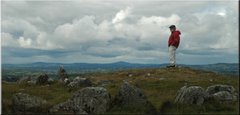
Pleasant Valley/Nigger Hollow
(Photo by Lynn Harrington, October, 1964)

The article I'm about to link for you contains true stories of murder, pathetic KKK meetings, heroic dogs, a neighbor across the way who was said to be a pretty decent fellow when he was on his medications, and much more in a riveting ten to fifteen pages.  Busch (who passed away four years ago) weaves a stream of prose that I find enchanting.

Here it is: Standoff in Columbus: Guns, dogs and the language of totality. Enjoy.

And now I'm going back to my break, finishing the quarter and preparing for what will come right after the frenzy of a short summer session. See you in September!

====================

Saturday, February 7, 2009

More Snow and Ice Images: Forty-Seven Years Ago

Now that it has snowed even on coastal South Carolina, and now that the annual, ritual mocking of California softies has been chanted by our Canadian cousin, I feel obliged to point out that not all of us lotus-eaters have always been so unfamiliar with snow. In fact, some of my favorite memories are of my youthful experiences with the stuff, in Chenango County, New York, downwind of Buffalo, in the fulsome blast-path of lake effect snows.

They are "favorite" memories, of course, because they don't come with the sting of melted and re-frozen water in my jeans, or the bite of frozen snot on my upper lip. They just come with visuals, so they are greeted fondly.

Among the fondest are ones captured by my Dad's camera in February, 1962. We had a brief thaw, followed by a deep and quick freeze, which worked absolute frozen hell on the roads, which turned into ribbons of thick and slick ice. But it also worked magic on the streams and creeks in the county's glens. The brief thaw caused water to run over the rocks -- and through them, too, since most of the rocks there are shale and other sedimentaries with plentiful interstitial pathways for fine streams of water -- to trickle down toward creeks and streams. The quick plummet in temperature then froze that migration in time, producing frozen waterfalls, icy stalactites, and colorful walls of petrified water tinted by the minerals it had passed through on its way to temporary stasis.

The images below are from that event, and were taken by my Dad, Lynn Harrington. Many of them have shown up over on PicShers, my photo-a-day blog, but these are linked to much higher-resolution versions than the ones over there are. If you click on any of these images, you will be taken to Flickr, where you can view them at as high a resolution as you can stand (click on the "all sizes" magnifying glass right above the image to access other resolutions.)

A Day in February, 1962 (1 of 6)
In "Gorgeous Gorge," a little tributary to Thompson Creek. Our house was on the south side of the Thompson Creek Valley near Kings Settlement, New York, and this glen was directly across the valley, on its north side.

A Day in February, 1962 (2 of 6)
I carefully trudge between a frozen waterfall and a flash-frozen exposed pool. My walking stick is an inverted golf club, a putter if I recall correctly.

A Day in February, 1962 (3 of 6)
Natty Bumpo trudges over a perilous waterfall. Click here for what this idyllic place in the glen looked like in summer.


A Day in February, 1962 (4 of 6)
A pause in the upper part of the glen, looking south and downstream.


A Day in February, 1962 (5 of 6)
View from the high ridge above the glen, southward toward home. If you click on this image and view it in Flickr, you'll see a box toward the right of the frame; it indicates our little house on the south side of the Thompson Creek Valley.


A Day in February, 1962 (6 of 6)
After that little walk, Dad and I (and Mom, seen here in her white parka) gathered up some wood trimmings from around the property and had a little bonfire.

White Store, NY, February 1962 (1 of 2)
This photo was probably taken either the day before or the day after the above ones were. Dad's sisters Myrt and Mary lived in a hollow off the Unadilla Valley, one ridge to the east of our place off the Chenango Valley. Their house was next to a creek with a significantly deeper and more dramatic gorge than the one Dad and I walked. This image shows, dramatically, the effects of minerals and dirt entrained in the water's flow on the color of the flash-frozen curtains. (I am leaning gingerly against an ice face in the background, Mom is in her white parka again, and I think that's my cousin Marjie in the red coat.)


White Store, NY, February 1962 (2 of 2)
Waterfalls frozen in time and in fact.

(The remarkable ability of modern photo scanning technology to reconstruct images' color has made these views seem immediate, but they're not. To get a sense of how long ago they were taken, beyond the dry quantification of "47 years," consider this: Dads' sisters' house is about a hundred yards behind us from this photo's vantage point. Inside that house was a telephone, but that telephone couldn't be accessed the way we're used to. Its number was "South New Berlin 3-Y-5," which had to be spoken, not dialed or punched in, to a live operator, who would then physically cause the 'phone to ring by plugging a big connector into a hole in her switchboard and pressing a button to send current down the line, ringing all of the bells on the party line, but in a code of longs and shorts that indicated for whom the call was intended. Sometimes it worked, but sometimes the neighborhood busybody would pick up her 'phone instead.)

============================================