Friday, September 2, 2011

Ireland Revisited: The Hill of Uisneach

Day 30 of 35: Thursday, September 2, 2010

Uisneach Denizens

This was to be our last true vacation day headquartered in the Bothy; Friday, our actual last full day, would be taken up mostly with packing to leave early the following morning. Today broke with clear skies and a light mist on the ground.

Two-panel panorama of the Bothy in the early light of September 2nd.

After I took a brief trip to the library and its internet connection, we set out for the Hill of Uisneach near Mullingar, said to be the ancient center of Ireland.

Along the way, we took an unplanned detour to see the southernmost tip of Lough Ennell through which the River Brosna flows (Mullingar is at the northern end.) The lake appears to be a great recreation asset for the local people, well away from tourist attractions and, of course, beautiful.

This area at the lake is called “Lilliput,” because of Jonathan Swift’s connection to the region: he frequently retreated to this area in general and this lake in particular to gain solitude for writing. A sign near the shore at this place provides a map of the Mullingar region for bicyclists and reads:
It’s time to take things slowly… Quiet country roads with stunning views of rich pastureland and beautiful lakes provide the ideal backdrop for your cycle routes. Enjoy some fresh air, peace and tranquility. Mullingar is your starting point. A busy market town with excellent facilities and amenities, Mullingar is finely situated on the River Brosna near the ancient centre of Ireland. Visit the beautiful Renaissance style Catholic Cathedral and admire breath-taking frescoes. Visit the local tourist office at the Market Square and see the statue of the late Joe Dolan, commemorating the life and music of Mullingar’s own and internationally renowned singer and entertainer. Venture north to Lough Owel and on to Multyfarnham with it’s [sic] 13th Century Franciscan Friary. Follow in the steps of ancient Irish warriors on the Táin Trail and cycle alongside the Royal Canal, built in the 1800s, and now a recreation amenity and wildlife haven. Cycle south around Lough Ennell, relax at Lilliput amenity area and visit the 18th Century estate at Belvedere where bike parking facilities are available. Whichever route you choose you will enjoy a pleasant cycle in a gentle landscape rich in lake and canal, lore and legend.
I’m sold, but I have no bicycle.

From the lake, we backtracked to our original destination, the Hill of Uisneach (pronounced “Oosh’-nuk”.)

The hill is not on public land, or administered by the OPW. It is on a working farm, and permission to enter should be obtained from the owner. The farmhand who gave us our map of the hill (left over from a Mayday celebration there, an annual New Age spiritual gathering called "the Festival of the Fires" at the traditional center of Ireland) also gave rather ambiguous directions for the easiest walk to the top. Against Diane’s better inclinations, she followed her husband on what turned out to be a very circuitous and rather arduous trudge through pastureland up the 600 feet or so of vertical relief. Not bad for someone on a bum ankle.

Clockwise from upper-left: Parking area and sign on the R390 road west of Mullingar, Diane trudging, more Diane trudging, and curious cows.

The summit features a variety of recent structures, mostly wicker – and an incredibly stunning 360° vista to the far reaches of Ireland. From that point, it is easy to understand why this place has been special in a number of ways for thousands of years.

==================================
More images from September 2nd, including a very large, 360° panorama of the view from the top of the Hill of Uisneach, are available in this slideshow on sharrington.net.
==================================

Next: September 3, 2010 -- Last Full Day in Birr
Previous: September 1, 2010 -- A Midlands Ramble
Beginning of the series: Prologue, August 2

Thursday, September 1, 2011

Ireland Revisited: A Midlands Ramble

Day 29 of 35: Wednesday, September 1, 2010

Dominican Priory ruins, Lorrha, Co. Tipperary

As we headed into our last three full days in the Irish midlands and I had finished my time in the archives for this trip, the urge to do a lot of running around to many places became almost overwhelming. Before Diane got going on this morning, I made a quick trip to the little village of Lorrha at a nexus of very back roads between Birr and Terryglass on Lough Derg, through which we had driven the previous evening on our way back from dinner at the Derg Inn. Lorrha turns out to have a number of attractive ruins in its vicinity, including the Dominican Priory, established in the 13th century and now serving as a graveyard adjacent to a modern church.

Details, Dominican Priory, Lorrha.

Once Diane was ready to go, we started on a three-county, generally west-to-east meander across nearby parts of the midlands. We started in Portumna, County Galway, a familiar town to us because we had traveled through it many times in 2006 and on this trip. We had always intended to visit Portumna Castle, but never seemed to have the time. We did so, finally, on this day.

Portumna Castle.

The castle – really an Elizabethan-style mansion – was built in the 17th century as the Irish headquarters of the English Clanrikarde family. It was almost entirely destroyed by fire in 1839, leaving only the stone outer walls intact, and was abandoned. The ruin was taken over by Ireland’s Office of Public Works (which administers and operates Ireland’s public antiquities sites) a few decades ago, and the OPW has been slowly restoring the place to an approximation of its 1700s state since the 1960s. Progress is slow because funding is sporadic. So far, only the ground floor is in shape for the public to visit.

From Portumna, we meandered back through the rural environs of Lorrha in North Tipperary, to look at a tower house in a farmer’s fields (Lackeen Castle), and then on to the town of Banagher on the Shannon in County Offaly.

Lackeen Castle (top) and Banagher's bridge across the Shannon.

Finally we followed the Shannon eastward and upstream to the ancient monastic ruins at Clonmacnoise. We had visited Clonmacnoise in 2006, and returned this time as much for its view of the Shannon as for the ruins themselves.

Clonmacnoise, the Shannon, and a fellow visitor.

And, then, finally home to Birr, the Demesne, and the Bothy. An evening stroll gifted us with a short visit with Miss Kitty, another with Lord Rosse (who was driving back from somewhere in the Demesne’s far reaches), and…

… two sociable horses and some of the last vestiges of the weekend’s fair.

==================================
More images from this day's wanderings are available in this slideshow on sharrington.net.
==================================

Next: September 2, 2010 -- The Hill of Uisneach
Previous: August 31, 2010 -- Back to Brú na Bóinne
Beginning of the series: Prologue, August 2

Wednesday, August 31, 2011

Ireland Revisited: Back to Brú na Bóinne

Day 28 of 35: Tuesday, August 31, 2010

We set out nice and early (but not uncivilizedly so) from the airport hotel to re-visit our friends the cows along the banks of the River Boyne. As long as we were there, we decided to nose around a part of the area’s megalithic wonders that we hadn’t seen four years ago.

OPW shuttle bus at the Brú na Bóinne site. Despite its destination sign, it's at the staging area for Knowth.

Cows at the Boyne, burial mounds at Knowth.

In 2006 we toured the largest of the 5,000-year-old passage tombs, Newgrange. This time, we took the blue OPW shuttle bus from the Visitors' Centre to the more distant Knowth cluster of mounds, including the largest and highest one, which you can see a bit of in the top photo on this post.

The passage tombs have been restored to various stages, allowing visitors to see the inner structure of some and the likely working appearance of others. The largest tumulus has two long passages toward chambers near its center (unlike Newgrange, which has one) aligned due east and west (the Newgrange passage is aligned with the winter solstice sunrise point instead). The outer end of the eastern passage can be viewed from a small room near its end, but the passage itself is off-limits to visitors.

Ireland's OPW has provided a path to the top of the largest tumulus, not the first time that a subsequent civilization has constructed things atop the builders' artificial hill. Archaeological evidence shows that it has been used many times over the past 5,000 years by different people as a fortress and even the site of a small village.

At left above, Diane (just to the right of the wood posts, a partial reconstruction of what was probably a ceremonial structure) lends perspective to the size of the large tumulus. The sweeping view from its summit of the Boyne valley is a lovely one; at right we are looking westward along the Boyne.

After our stay at Knowth and the Brú na Bóinne complex, we drove back to Birr along a leisurely route, one designed more for its own sake than for speed. Major highways in Ireland, including the new superhighways, are laid out like spokes radiating from Dublin toward the other relatively large cities on the island. We purposefully worked our way across that plan, traveling an arc across the midlands. Our time in Ireland was dwindling toward its end as August prepared to give way to September, and we were in no rush.

==================================
More images of the Knowth complex are available in this slideshow on sharrington.net.
==================================

Next: September 1, 2010 -- A Midlands Ramble
Previous: August 30, 2010 -- Powerscourt and Howth
Beginning of the series: Prologue, August 2

Tuesday, August 30, 2011

Ireland Revisited: Powerscourt and Howth

Day 27 of 35: Monday, August 30, 2010

Howth Harbour at dusk.

Another brilliant morning, this one accompanied by the sounds of a small city being disassembled – the tents and other structures of the Irish Game and Country Fair being taken down and away. The complete process would take several days.

While Diane was preparing for our trip to the Powerscourt House and Gardens (and our overnight stay in Dublin), I visited the Demesne’s science museum, primarily to photograph some items concerning the 4th Earl (who gradually had become the focus of much of my archives explorations.) I was specifically looking to take some pictures of a birchbark canoe he had shipped back from Canada on his first trip to North America in 1884:

(Portrait of the Fourth Earl of Rosse courtesy of John C. McConnell, original photographer unknown.)

Three weeks before this day, we were preparing for our first excursion away from Birr, the one to County Antrim that wound up in the hospital at Coleraine and changed the nature of the rest of the stay in Ireland. While packing for that trip, Diane tucked her passport away in her suitcase in one of those nooks and pockets that modern suitcases seem to have a pox of. That action was forgotten, understandably, in all that happened later in the Northern Ireland adventure.

A couple of weeks later, she couldn't locate her passport while sorting through things in her shoulder bag. Having forgotten hiding it away in that odd suitcase pocket, she thought it lost, and we set up an appointment with the US Embassy in Dublin for an emergency replacement. (While the prospect of being stuck in Ireland wasn't entirely displeasing, we did have family and beasties back here in the US that we needed to return to.) Embassy staff were very helpful, as were the people at the Birr Library where we needed access to scanners and the internet. We were set up for an appointment on the morning of Tuesday, August 31st -- the day after this one -- so we made a hotel reservation in Dublin for this night, Monday the 30th.

While packing for the jaunt to Dublin, of course, the passport was found. So we cancelled the Embassy appointment, but kept the hotel reservation and made a 2-day holiday-within-a-holiday of it.

We set out for Powerscourt in the Wicklow Mountains at around noon and were there in only about two hours – the new ease of long-distance auto travel in Ireland continued to impress us. We were initially disappointed that more of the grand house is not open for viewing – and the parts that were (most of the ground floor) are given over to shops – but forgot about that pretty quickly in the overpowering sweep of the gardens and grounds in general.

Clockwise from upper-left: the great house from the terraced gardens, its domes reminding us of the Armagh Observatory three weeks earlier; Triton’s fountain and pond; Sugarloaf from the forest at the demesne’s far reaches; a bee at work in the walled garden (can you find him?)

Many more photos from this beautiful day at the Powerscourt Gardens are available in the day's slide show over on sharrington.net.

We stayed the night at the same airport hotel that we have always used (for familiarity and price, not because we’re particularly charmed by it – it’s serviceable and acceptable for a crash pad), planning to get up early tomorrow for a return visit to Brú na Bóinne. We had some time after dinner before the sun set, and decided to see if Howth harbour is as charming in 2010 in the evening as it was in 2006 at midday.

Oh, my.


==================================
Many more images are available in this slideshow on sharrington.net.
==================================

Next: August 31, 2010 -- Back to Brú na Bóinne
Previous: August 29, 2010 -- A Fair Day, Too
Beginning of the series: Prologue, August 2

Monday, August 29, 2011

Ireland Revisited: A Fair Day, Too

Day 26 of 35: Sunday, August 29, 2010

I attended a Sunday church service for the first time in decades today, at Lord Rosse’s invitation. During the organ recital a week ago, he had pointed out the memorial plaques on St. Brendan’s inner walls, many of whom are for Parsons family members, especially the Earls. He made special note of a very large one for the Third Earl (the “telescope Earl”), high up behind the balcony, seeming to look down on the congregation, the pulpit, and the altar. I hadn’t brought my camera then, thinking it would be out of place and somewhat disrespectful at a small music recital in a church, but Lord Rosse encouraged me to come back with it to the following Sunday’s service. So I did, but kept it hidden under my hat on the pew beside me during the service itself.

Right, above: the third Earl’s memorial plaque. The last sentence is, “He was renowned in the loftiest range of science, and he revealed to mankind by the unrivalled creation of his genius a wider vision of the glory of God.” The memorial is about five feet tall. Left, above: outside the church is a recent sign which commemorates the world’s first automobile fatality, which took place in the road at the place where I was standing to take the photo. It occurred in 1869, two years after the third Earl died, under the iron wheels of a steam-powered vehicle of his design. The victim was one of his cousins, Mary Ward, herself a noted scientist, a pioneer in microscopy. More about Mary Ward and about this accident can be found in the second part of this earlier post on SherWords.

This afternoon Diane and I thoroughly enjoyed the last hours of the Irish Game and Country Fair, including:


... a display of carriage driving by the Birr Equestrian Centre...

... and another fascinating round of falconry.

Two little creatures particularly delighted us, a champion terrier and a small African vulture.

The next-to-last event at the Fair’s main arena was the “Final of the Five Nations Working Terrier Championships,” in which the year’s winners from previous fairs in Ireland, Northern Ireland (which was described by the M. C. as “technically another country”), Scotland, Wales, and England were squared off against one another for the year’s final round of judging. The winner was this little black guy from England:

During the entire awards ceremony, he was absolutely fixated on the second-place trophy, a stuffed fox head, and would pay attention to nothing else.

The African vulture, the opening act of the falconer's final show, was just about as cute as a buzzard could possibly be, and "cute as a buzzard" are four words I never thought I'd string together.

He responded to the sound of the falconer’s voice like a well-trained dog might, he worked the crowd at the fence (which he’s doing in this picture) masterfully, and his bouncing, rolling, lurching ground gait was hysterical. While only about the height and weight of one of our chickens, his wingspan was impressive:


Afternoon fades on the fair's last day.

==================================
Many more images from the two-day event (including links for further information on some of the activities) are available in this slideshow on sharrington.net.
==================================

Next: August 30, 2010 -- Powerscourt and Howth
Previous: August 28, 2010 -- A Fair Day
Beginning of the series: Prologue, August 2

Sunday, August 28, 2011

Ireland Revisited: A Fair Day

Day 25 of 35: Saturday, August 28, 2010


This day was the first of two in the Demesne devoted to the Irish Game and Country Fair, now an annual event at Birr Castle. (Birr was not yet a stop on the Great Game Fairs circuit when we last visited in 2006.) It turned out to be very enjoyable -- and a very big deal. Newspaper accounts in the following week pegged the two days' total attendance at about 35,000 people.

Since the Bothy is inside the Demesne's walls, we could watch the literally last-minute preparations and the opening of the gates (please click on any image to see it in a larger format):


Above right is the scene at the gate nearest us (there were two others, one by the Croghan Lodge at the far end of the public park part of the Demesne from the castle, and one far back in the farming area where the shooting events were held.) The arrivals were a trickle at first, but by mid-afternoon, the place was awash with people.

Things we saw during the day (in addition to many, many vendors of food and wares) included:

A demonstration of western riding techniques and clay pigeon shooting...

... terrier racing (a hoot!) and...

... lurcher racing...

... falconry, and a horse and hound display by the local Ormond Foxhounds hunt club. While the hawk pictured above was content with short flights from the falconer and his bait, his kite seemed to enjoy the afternoon as much as any human, staying aloft and circling the main arena for well over an hour with only occasional stops in nearby treetops.

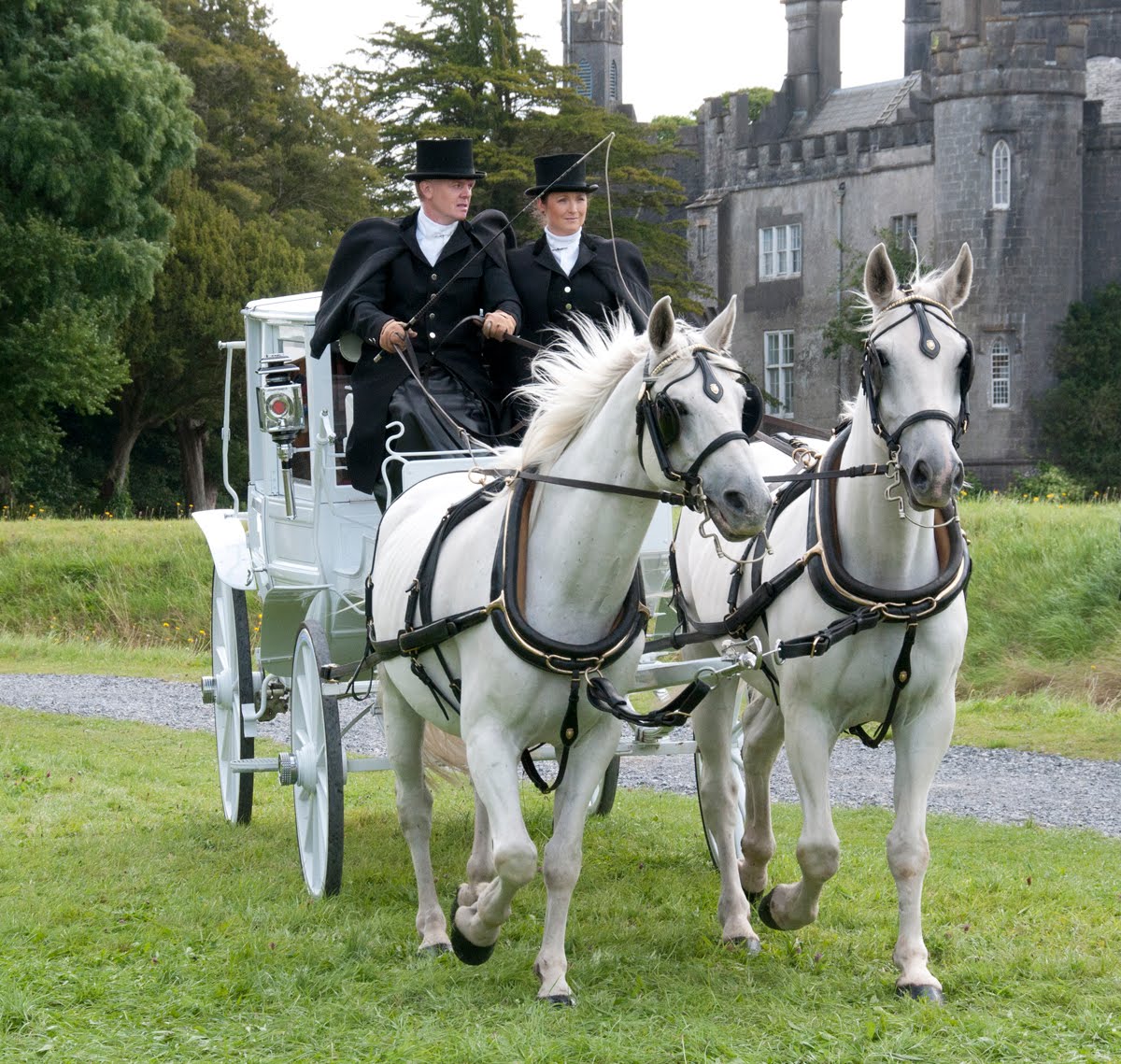
Lord and Lady Rosse made a grand entrance around midday:


Lady Rosse told me the next morning at church that their carriage ride had come as a surprise ("I wasn't dressed for that at all!") The coach and pair are owned by the couple at the reins, and they rent out for weddings and such. They had volunteered their services for a similar entrance at last year's Fair, but weren't expected to do so this year.

I'm glad they did.

==================================
Many more images from the two-day event (including links for further information on some of the activities) will be linked at the end of tomorrow's post.
==================================

Next: August 29, 2010 -- A Fair Day, Too
Previous: August 27, 2010 -- Before the Fair
Beginning of the series: Prologue, August 2

Saturday, August 27, 2011

Ireland Revisited: Before the Fair

Day 24 of 35: Friday, August 27, 2010


This day was one of several on this trip which felt a little like we imagine most days would be if we actually lived in Birr. For me, that entailed a little work (research in the archives, writing, and continuing the bench panoramas photography project), some errands, and a lot of slacking off. Missing, of course, were family and animals, and those are not minor things.

My time in the Archives on this morning was spent trying to get a little more of a feel for what the 4th Earl of Rosse was like as a person. I came across accounts of an incident early in his earldom, in 1868, when he and his brothers were arrested by a couple of drunken policemen. The incident’s last reference in the archives was a letter to the 4th Earl by the head of Ireland’s constabulary, which included this bit of highly-accomplished groveling:


A fuller account of this episode is included in this earlier SherWords entry.

The day was brilliant with plentiful sun and dramatic clouds. Diane and I spent most of midday shopping downtown.


The above corner of Emmet Square, looking almost due north, includes the brick post office building and, to its left, grey buildings that contain offices of the Enrights’ enterprises and Enright’s Bar (the short building immediately to the left of the P.O.) Birr’s most famous current musician, Mundy (Edmund Enright) occasionally still helps out there, pulling perfect (it’s said) pints of Guinness for customers.

In the late afternoon and evening we strolled around the Demesne, watching final preparations for the weekend’s Irish Game and Country Fair. While doing so, we stumbled on a part of the Demesne we had never seen before, the “Secret Winter Garden” and its thatched-roof gazebo.

Vendors' tents being prepared for the 2010 Irish Game and Country Fair. The structure in the background at right is part of the support structure for the great telescope.

Secret Winter Garden, Birr Castle Demesne.

At the end of the day we strolled past our old friend’s hangout. She was there and, after a short conversation, followed us back to the Bothy for a snack. She is still very, very wary, stopping every few yards to look all around nervously – but I don’t think she needs to worry about the obnoxious Bichon any more. We hadn’t seen it running loose since we mentioned it to Lord Rosse a week earlier.

==================================
More images from this day can be seen in this slideshow over on sharrington.net.
==================================

Next: August 28, 2010 -- A Fair Day
Previous: August 26, 2010 -- Brian Boru's Revenge
Beginning of the series: Prologue, August 2

Friday, August 26, 2011

Ireland Revisited: Brian Boru's Revenge

Day 23 of 35: Thursday, August 26, 2010

At the end of our long, busy day on Wednesday, we treated ourselves to dinner at one of Killarney’s supposedly better restaurants – and Diane’s lobster and my rack of lamb were delicious. Something in my meal obviously hated me, though, because I woke up at about three on Thursday morning with a very aggressive case of the disgustings – maybe we can call it Brian Boru’s Revenge. Luckily, my system seemed to have emptied itself of offending rich dinner by checkout time, and we could undertake the three-hour drive back to Birr, even though I was otherwise still feeling pretty much awful. On arrival back at the Bothy, I crashed on the bed and slept for 16 hours.

Diane evidently felt fine and, bless her soul, didn't smirk at me even once, so far as I could tell.

The only photo taken on Thursday, August 26th.

==================================

Next: August 27, 2010 -- Before the Fair
Previous: August 25, 2010 -- Killarney
Beginning of the series: Prologue, August 2